






 Jesus and the Zealots Interview
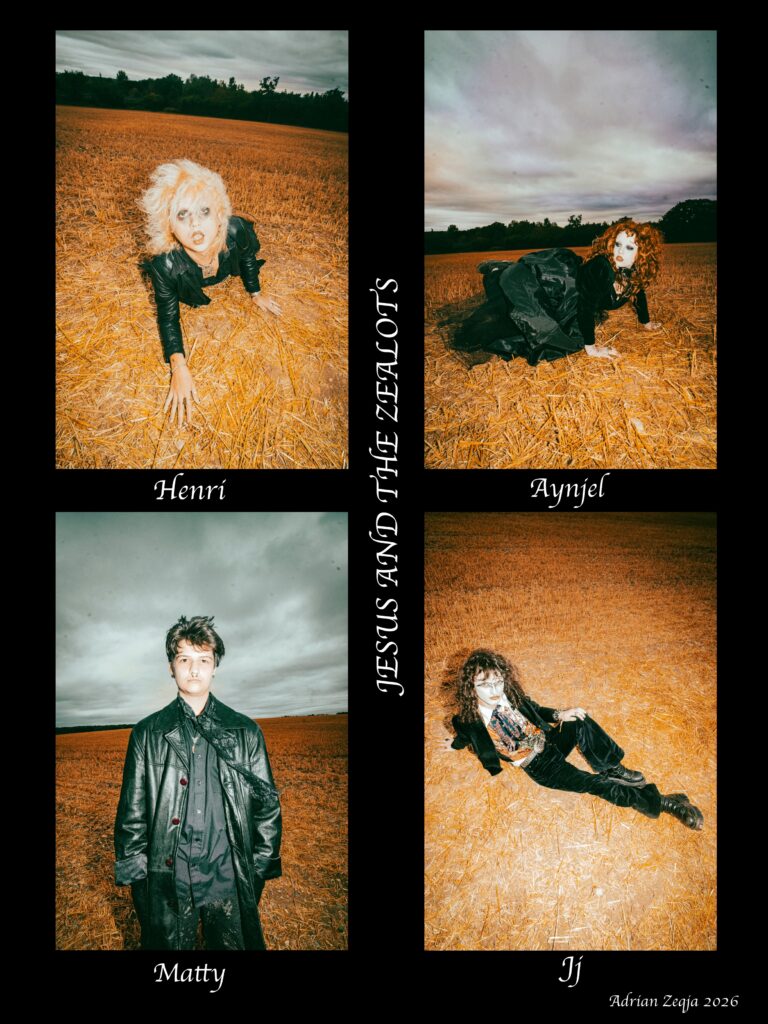
Finding faith, identity and beauty in the darkness
words by Kasia Krawczyk
There’s something wonderfully unconventional about the way Jesus and the Zealots came together. A chance discovery in Southbank, a pilgrimage to Jim Morrison’s grave and a prayer for a synth player might not sound like the usual beginnings of a band, but then again, nothing about this London outfit feels particularly ordinary. Blending gothic rock, folk horror and ’60s psychedelia with a theatrical visual identity, they’re building a world that feels as much like an art project as it does a musical one.
Their latest EP, The Mask, is the latest invitation into that world. Released after a year of writing, refining and shaping their sound, the project brings together darker themes of grief, faith, identity and the different versions of ourselves we present to the outside world. But beneath the gothic imagery and mysterious characters, there’s something deeply human at its centre.
Speaking ahead of their sold-out Halloween show at Hackney’s Paper Dress Vintage, the band opened up about the unusual story behind their formation, the personal experiences that shaped The Mask and why, sometimes, getting dressed is just another way of telling a story.
A band brought together by fate
For a group with such a distinctive identity, Jesus and the Zealots have an equally unusual origin story. Asked how they found each other, the band described their formation as something of a puzzle, with music, coincidence and a little spiritual intervention playing their part.
“It started from finding a book in Southbank called Jesus and the Zealots,” they explain. “Me, JJ and Henri have known each other for years through music, and we magically came across Matty after we went to Jim Morrison’s grave, put a Jesus and the Zealots sticker there and prayed for a synth player.”
It’s not exactly your conventional band origin story, but perhaps that’s the point. Their music operates in a similarly unpredictable space, pulling together gothic rock, folk horror, ’60s psychedelia, art and high fashion into something that refuses to sit comfortably in one genre.
Behind the mask
With The Mask now out in the world, the band are particularly excited to have a complete body of work for listeners to experience. Rather than simply collecting a handful of singles, the EP has been designed as a project with its own atmosphere, narrative and identity.
“We’ve been working on it for so long. These songs are a culmination of a year’s work, trimming it down,” Henri explains, adding that they also took on the mixing themselves.
For Aynjel, however, the excitement goes beyond finally releasing the music. “It’s really nice to have a full project out because we’re quite into concepts as well, and The Mask has its own world. It’s nice to put a full piece of art out for people to listen to.”
That world is populated by darker ideas, but the stories behind them are far from purely fictional. Grief, religion, insecurity and identity all find their way into the EP, with different members bringing their own experiences into the band’s collective vision.
The title itself comes from a recurring character that has appeared in their music before, including the single ‘I Again’. The Mask is less a literal figure than an unsettling presence: an entity representing time, something that is always looming, even when you cannot quite see it.
“It’s from a different world,” the band explain. “It’s an entity, and it’s always there, and you can’t necessarily see it.”
But some of the EP’s darkness comes from much more personal territory. Matty opens up about growing up with religion while navigating their own identity.
“My parents are pastors. They’ve always run a church, but I’m also trans, so I’ve got a lot of differing opinions on religion,” they explain. “It’s quite nice for the music to touch on that at points.”
It’s an interesting tension: being raised around faith while developing a relationship with it that isn’t necessarily straightforward. Rather than offering easy answers, the band allow those contradictions to exist within the music.
That sense of conflict also feeds into ‘Hold the Night’, the EP’s opening track. When developing the accompanying music video’s storyboard, Aynjel and JJ explored the experience of masking, particularly in relation to neurodivergence and the exhaustion of constantly having to present a particular version of yourself.
They discussed “the feelings of insecurity about masking, being neurodivergent, and the struggles of having to produce that face and keep it on for extended periods of time.”
It’s a subject that gives the EP’s title another layer of meaning. Beyond its mysterious, almost supernatural character, the mask becomes something recognisable: the face we construct to navigate the world, even when keeping it in place takes more energy than anyone realises.
Making something personal feel universal
Perhaps the most emotional moment on The Mask comes with ‘You’, a song dedicated to a friend the band sadly lost a few years ago.
For one member, the track emerged during a period of uncertainty, when grief and questions of faith became difficult to separate.
“There was a time, for a few months, where I just didn’t know what to do with myself,” Henri recalls. “I ended up talking to a chaplain at my university who was trying to sort of convert me to God, and I was questioning faith and didn’t really know what to believe. A lot of it comes from the confusion of that.”
It’s this willingness to sit with uncomfortable emotions that makes the band’s songwriting particularly compelling. Rather than spelling everything out, they leave room for listeners to find their own interpretations.
Aynjel, who writes much of the band’s lyrics, describes being drawn to the poetry of language rather than always aiming for straightforward storytelling.
“I like to think about how other members of the band think and perceive the world. I’m a bit of an empath,” they explain. “The problem with me is I really like the poetry of words, and maybe it’s not as straightforward as you would think listening to our songs.”
For them, that ambiguity is part of the beauty of making music. “It’s nice for people to get what they feel out of our tracks, not necessarily know what it is. I think that’s a really nice and special thing.”
It’s an approach that makes The Mask feel less like a collection of answers and more like an invitation to explore. The experiences might be deeply personal, but the feelings behind them are universal enough for listeners to recognise something of themselves.
The sound behind the spectacle
Visually and musically, Jesus and the Zealots are clearly drawn to artists who understand the power of atmosphere. When discussing their influences, the band point towards The Mission as a particularly important reference point, especially when it comes to guitar work and lyrics.
“We’re all big fans of The Mission. We always say this in every interview,” they laugh. “They’re definitely our biggest influence in terms of the guitars and the lyrics.”
JJ singles out The Birthday Party, particularly Rowland S. Howard’s distinctive guitar playing, describing him as a major influence on the band’s current material.
The references make sense. There’s a certain theatricality to their sound, but also an appreciation for the darker, more atmospheric side of alternative music. It’s a combination that allows them to move between gothic textures and psychedelic experimentation without losing their identity.
Dressing for the world they create
Of course, the music is only one part of the Jesus and the Zealots experience. Their visual identity is just as carefully considered, from the clothes they wear to the worlds they create around their songs.
Asked about the importance of fashion and aesthetics, the band are quick to point out that their look isn’t simply a costume designed for the stage.
“We’ve sort of always dressed like this in different ways,” they explain. “It’s very real for us. It’s not put on, and clothing builds the world as well.”
Currently drawing inspiration from new-romantic styling and Victorian fashion, their clothes help communicate the atmosphere of the music before a single note is played.
“It tells the story of our music, and we feel like us in these clothes,” they add. “And that’s really nice. And we don’t have to mask.”
It’s a fitting observation for a band whose latest EP spends so much time exploring the idea of hiding parts of yourself. Here, fashion becomes the opposite of a disguise: a way of expressing an identity rather than concealing it.
A sold-out homecoming
Our conversation takes place in Hackney, just before the band are due to take the stage at a sold-out Paper Dress Vintage. It’s a particularly meaningful venue for them, having hosted their very first gig.
“We’ve played at Paper Dress Vintage a few times. It’s where we did our first ever gig, and to sell it out is just like, we can’t believe it,” they say.
For a band that has spent so much time carefully building its own universe, seeing an audience show up to experience it feels like a significant moment.
As for what they hope people take away from the performance, the answer is refreshingly simple: they want everyone to enjoy themselves, connect with the songs and dance.
“We just hope the audience really enjoys the songs and has a good time with us and dances and has a lovely evening.”
And perhaps that’s the most interesting thing about Jesus and the Zealots. For all the gothic romanticism, religious symbolism and mysterious characters, there’s no great desire to make their world inaccessible. Beneath the darkness is a band interested in connection, honesty and creating a space where people can feel comfortable being themselves. At the heart of their sold out Halloween show was a true community, a safe space where goths and misfits from all over London came to support the band.
With The Mask, they’ve opened the door. Now they’re inviting everyone else in.