






 Interview with Manny Moura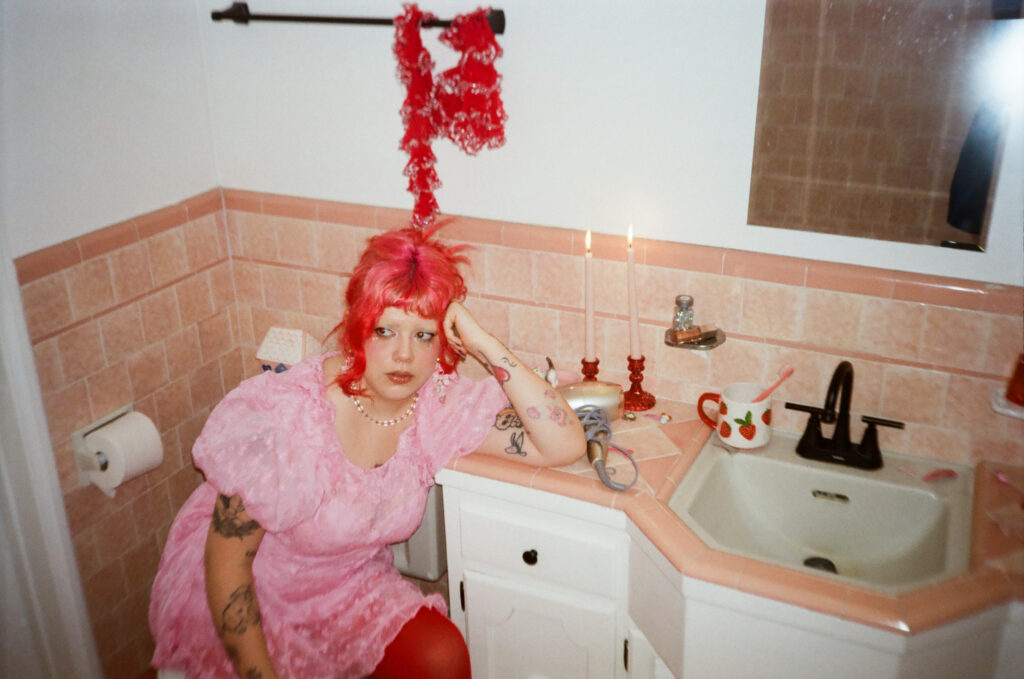
Manny Moura Is Learning to Live With the Mess
Words by Kasia Krawczyk
On anxiety, comparison, changing her appearance, the strange beauty of a crowd, and turning a difficult year into “Product of a Panic Attack.”
Manny Moura knows what it feels like to watch everyone else move forward while you’re standing still.
Last November, during what she describes as one of the hardest periods of her life, Moura sat down at a piano and started writing. Manny was living in Los Angeles, watching friends around her land major opportunities and seemingly become everything they were supposed to become, while she felt increasingly lost.
The result was “Product of a Panic Attack,” a song that refuses to tidy those feelings up. It is anxious, self-aware, funny, vulnerable and, at times, brutally direct. There is no attempt to disguise the uglier parts of comparison or loneliness. Instead, Moura puts them front and centre.
“I felt like people were doing better than me,” she says. “It’s not a nice place to be, mentally.”
Los Angeles only intensified that feeling. For Moura, the city could make other people’s success impossible to ignore. Friends were doing “these big things,” and although she was genuinely happy for them, their success became a mirror for everything she felt he wasn’t doing.
“I started feeling very small,” she says. “It’s an ugly feeling and it’s sort of inevitable. This city is weird.”
That tension runs throughout “Product of a Panic Attack.” The song captures the particular kind of anxiety that comes from feeling as though life is happening everywhere except where you are. It is about friendships and dating, about being left out, about watching people change while wondering why you haven’t changed with them.
But Moura isn’t interested in portraying herself as a passive victim.
The song began with a bad year
“I wrote this in November of last year,” Moura says. “Honestly, last year was pretty hard. My mental health was in a very weird place, and I was feeling quite lost.”
The songwriting became a way of confronting that feeling rather than trying to outrun it.
Moura has always been direct about her emotions, which made the honesty of the song less difficult than it might sound on paper.
“To be honest, it was easy,” she says. “I am a very direct person, and I’m usually aware of what I’m feeling.”
There is something almost refreshing about that admission. “Product of a Panic Attack” isn’t an accidental confession. Moura knew exactly what she was doing when she put those thoughts into a song.
“I wrote this song because I felt like I had to get these ugly feelings out of me and it was a healing process.”
The ugliness matters. Rather than transforming anxiety into something inspirational, Moura allows it to remain uncomfortable. There is envy. There is insecurity. There is loneliness. There is the nagging suspicion that everybody else has figured something out that you haven’t.
And then there is the urge to change something—anything.
A new hair color won’t fix your life
One of the song’s sharpest images involves dyeing your hair and hoping you’ll somehow believe you’ve changed along with it. For Moura, that isn’t just a clever lyric. It’s something she recognizes in himself.
“I’m addicted to changing my appearance because it’s an easy way to control something when I’m feeling out of control,” she says.
Hair, in that sense, becomes a small act of rebellion against uncertainty. You can’t necessarily control what happens around you, but you can change the person staring back at you in the mirror.
“Hair is such an interesting form of self expression,” Moura says. “I’ve never been too attached to what I do to my hair because it grows and the color will always fade, so I love the freedom that gives me.”
It’s a fitting metaphor for the song itself. Change the colour. Change the look. Start again. Maybe this time you’ll feel different.
Maybe you won’t.
Making the panic audible
Musically, “Product of a Panic Attack” doesn’t simply describe anxiety—it tries to recreate it.
Moura wrote the song alone on the piano, and when the bridge began to emerge, she didn’t pull it back.
“The bridge just happened, and I kept going on and on,” she says.
When she brought the song to Rodrigo, who produced it, Moura already knew exactly what she wanted the moment to feel like.
“I told him I wanted it to feel like a panic attack and that the bridge was the climax.”
The result is a section where the song seems to lose its balance for a moment, spiralling toward its emotional peak.
“I’m glad it came across like that!” Moura says.
That instinct—to let the song become as chaotic as the feeling it describes—is central to what makes “Product of a Panic Attack” work. The song doesn’t observe panic from a safe distance. It steps directly inside it.
The contradiction of the crowd
There is another contradiction at the heart of Moura’s relationship with anxiety: she is scared of crowds, but she loves them.
Especially at shows.
“I’ve always found crowds so beautiful, especially crowds at shows, singing in unison,” she says. “It makes me cry. To me, that’s the best thing in the world.”
It’s an oddly perfect contradiction for someone whose music is so concerned with isolation. A crowd can be overwhelming, but a crowd at a concert can also erase the feeling of being alone.
“It does make me anxious,” Moura admits. “But even through the worst of my panic attacks, I’ve always gone to shows and been part of the crowd.”
There is no clean resolution to that contradiction. Moura doesn’t suddenly stop being anxious because she loves live music. Instead, performing seems to have given her another way of understanding the thing that scares her.
“Being on stage and seeing a crowd from up there does help!”
For someone who has spent so much time feeling as though she is watching life happen from the outside, the stage offers a different perspective.
From there, the crowd isn’t something to escape.
It’s something singing back.
“I made it like that”
The song’s final turn is perhaps its most revealing.
By the end, Moura sings, “I made it like that”—a line that could easily sound like self-blame. But for her, it is more complicated than that.
“I’ve always been afraid of having a victim mindset where I blame everything else except for myself,” she says. “Lack of self-awareness terrifies me.”
That doesn’t mean she believes every difficult thing that happens is someone’s fault, or that anxiety can simply be willed away. In fact, Moura acknowledges that there was a point when his anxiety stopped being merely uncomfortable and became destructive.
“In moments of spiralling and panic attacks, it’s easy to feel sorry for yourself and like your life is just so hard.”
Then comes the distinction that matters to her.
“Some anxiety is good, but the amount of anxiety that I was having was paralyzing and destructive.”
For Moura, the line is ultimately about accountability. She doesn’t necessarily claim that her perspective represents the complete truth of what happened. Instead, it represents what the experience felt like from inside it.
“This song is me taking accountability for my own actions, probably to a fault,” she says. “I am this way because I made myself be this way and I am the only one who can fix it.”
It is an uncompromising philosophy, and Moura is aware that it may go too far.
“It’s not necessarily the full truth but that’s how it felt in the moment.”
Still, the instinct behind it extends beyond the song.
“It’s also how I approach life in general—understanding my flaws and fixing them.”
There is, finally, the question of what comes next.
After all the anxiety, self-analysis and uncertainty, there is still ambition underneath it all. Moura is making music, performing, changing, figuring things out. The song may have been born from feeling stuck, but releasing it is itself a form of movement.
So, naturally, there is one question left to ask:
Are you a star or a freak?
Moura doesn’t hesitate for long.
“Omg. I wish I was a star but I am probably a freak, let’s be honest.”
Then, almost immediately, she finds the upside.
“And that’s ok cuz freaks are pretty cool.”
Maybe that is where “Product of a Panic Attack” ultimately lands—not in certainty, and certainly not in some neat resolution, but somewhere stranger and more useful.
Moura is still anxious. She still compares himself to other people. She still changes her hair when life feels out of control. Crowds still make her nervous, even as they move her to tears.
But she is also making something out of it.
For now, that’s enough.
And if being a little bit of a freak is the price, Moura seems perfectly willing to pay it.
Photo by @gabrielitcha