






 Interview with Orchid
ORCHID FINDS THE BEAUTY IN BREAKING DOWN
On “Beach Gothic“, heartbreak has a soundtrack, paradise has a dark side, and the road to becoming a pop star begins with learning how to turn pain into something entirely your own.
words by Kasia Krawczyk
There is something particularly cruel about being miserable somewhere beautiful. The sun is out, the drinks are cold, the hotel looks like something out of a dream and everyone around you seems to be having the time of their lives. You might even look the part yourself. But somewhere beneath the carefully assembled outfit and the holiday photos, something is quietly falling apart.
For Orchid, that contradiction became the starting point for Beach Gothic, a project that finds beauty in uncomfortable places and treats heartbreak as something considerably more complicated than a sad song and a period of recovery. Here, pain can coexist with pleasure, grief can become glamour, and a seemingly perfect setting can feel like the loneliest place on earth.
At the centre of it all is “Elevator Eternal”, a song born from Orchid’s first experience of heartbreak. Its premise is deceptively simple: imagine yourself in a beautiful hotel, surrounded by every possible comfort, waiting for someone who is never going to arrive.
“I could be in the most beautiful place or at an amazing party or whatever, and in the back of my mind, there was still all of this pain that wouldn’t go away,” she explains.
The song originally began life as a bossa nova composition, before evolving into the clubbier pop track it is today. Orchid’s affection for Brazilian music came with an appreciation for its particular emotional contradiction: something can sound gorgeous and soothing while carrying an unmistakable sadness underneath. She was drawn to the eerie quality of the genre too and the way it has, in some contexts been reduced to the sort of background music you might hear in a hotel lift.
That image stuck. An elevator becomes a place of suspended anticipation, a soundtrack plays while life appears to unfold perfectly around you, and somewhere beyond the doors is the person you keep expecting to see.
“You’ve got a cocktail, you look great, you’ve got a nice view, everyone’s looking after you, but really you’re just waiting for one person to come down the elevator but they never, ever, ever arrive.”
It is a remarkably precise image for a feeling that is otherwise difficult to articulate: knowing something is over while being unable to stop expecting it to begin again.
“Your head is over it, but your heart’s still searching for something to happen,” Orchid says. “For me personally it’s really about heartbreak. But I think it could be any kind of grief where you cannot accept deep down that it’s what it is.”
The experience was painful, but Orchid has no interest in pretending that pain was entirely without value. Looking back, she describes it as a moment of discovery, an initiation into a feeling she had never quite understood before.
“I was like, wow, I feel really human. I feel really alive. And I feel really alive because I know I could break at any point.”
There is something almost addictive about that heightened state of being. Everyday anxieties recede when a feeling becomes so enormous that it takes over everything else. Orchid is careful not to dress suffering up as some noble pursuit, but she recognises the strange intensity of being forced to confront yourself without the usual distractions.
“It feels way more real than any other problems you might have – your day-to-day stresses and work and stuff around you. It’s like, this is so real.”
That emotional intensity runs through Beach Gothic, but the project is not simply an exercise in romantic misery. If anything, Orchid seems interested in what happens after the worst of it: the strange, sometimes contradictory ways people rebuild themselves, and the versions of happiness they reach for when the one they wanted proves impossible.
On “DRIP”, transformation becomes something material. It is the glow-up after the tears, the money made after bleeding over somebody, the impulse to turn personal devastation into something that looks spectacular from the outside.
“It’s like, okay, well, I guess if I can’t be happy, I’ll be rich,” she says. “And I guess if I can’t be loved, I’ll be hot.”
She is quick to point out that this is not necessarily a healthy philosophy. It is simply an honest one. Sometimes the desire to become untouchable is less about vanity than about finding a way to survive feeling vulnerable.
Elsewhere, “Skyscraper” captures a different kind of contradiction: a night when everything around her felt wrong, yet she found herself unexpectedly inspired, grateful for the small pieces of life she had managed to put together. The darkness and the light are not competing forces so much as two things that can exist at once.
“I think I’m both people,” she says. “I can find the dirt in something beautiful, and I can definitely find the light in something really hard.”
That duality gives Beach Gothic its title and much of its emotional vocabulary. The beach is supposed to be an uncomplicated symbol of escape: blue skies, warm sand, a chance to leave your problems behind. But Orchid sees something more unsettling and transformative in the sea itself.
“Every time I go to the sea, I’ll always look at it and never really know, is this the beginning or is it the end?”
The ocean is where life begins, but it is also where things disappear. It marks a boundary between one world and another, offering the possibility of renewal without promising that anything will actually be different when you return.
“You go to the sea and you feel refreshed. You feel like you can leave some things behind. You wash yourself and you come back feeling new.”
It is a beautiful sentiment, though Orchid’s version of transformation is refreshingly unsentimental. There is no suggestion that a holiday, a new outfit or a spectacular night out can magically undo heartbreak. Sometimes you can be somewhere extraordinary and still cry every day.
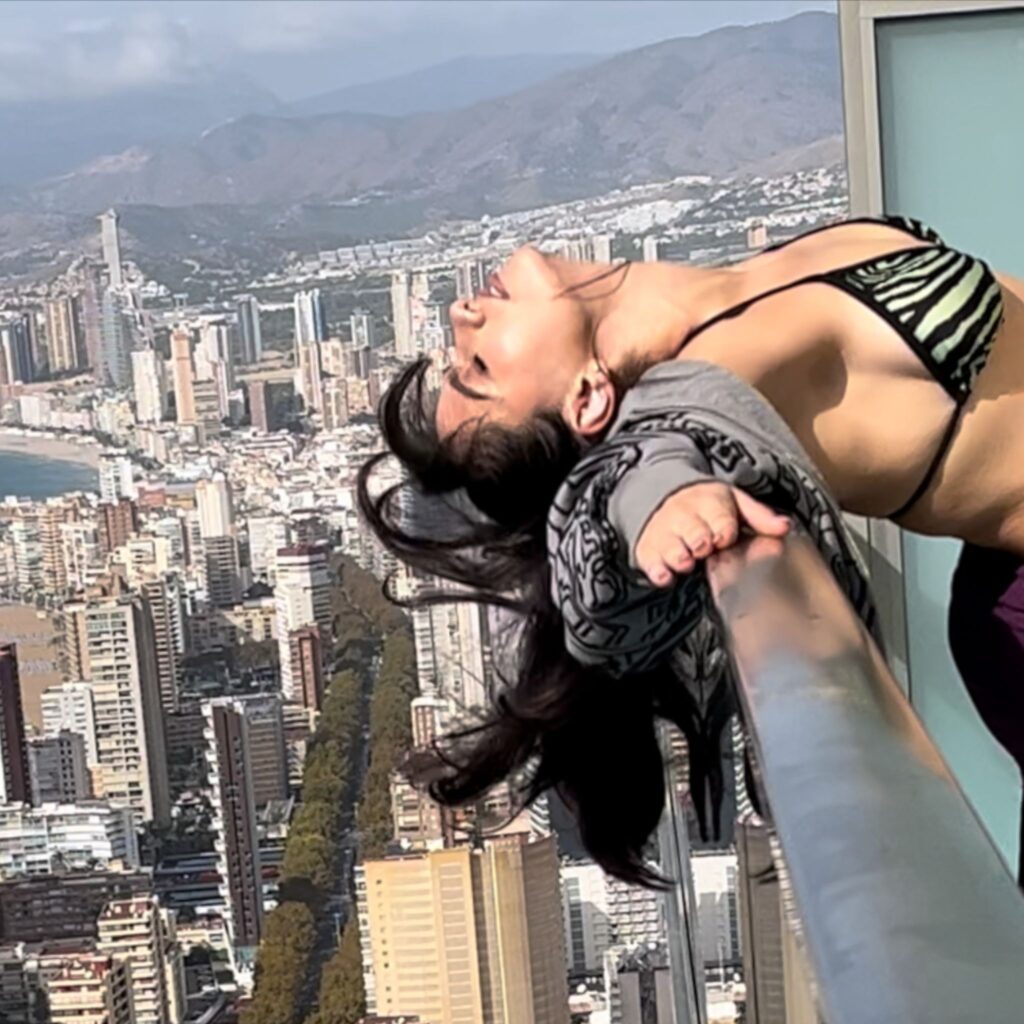
For the visuals accompanying the project, she travelled to Benidorm with a couple of friends, shooting footage in a destination not typically associated with the sort of alternative pop aesthetic she was developing. The location was deliberately unexpected. Benidorm’s familiar holiday atmosphere offered a contrast to the more stylised, slightly uncanny world she had imagined for the music.
Then she found the hotel.
“I found it on Google Maps and I was like, oh, there’s this hotel from the ’80s. It looks like it hasn’t been touched. This is perfect.”
The setting seemed to have been waiting for her: an old-fashioned hotel bar, a ballroom that was no longer being used, older couples relaxing beside the pool. Orchid and her friends asked permission to film and take photographs, then set about creating their own little world within it.
It was an exercise in making something out of very little. There was no elaborate production budget, no enormous crew or carefully constructed set. Instead, there was a location that happened to fit the idea, a group of friends and the freedom to see what might happen.
“It’s very fun creating art with your friends and being very fluid and collaborative, just seeing what happens,” she says.
Orchid speaks enthusiastically about the current state of pop music, arguing that the genre is being appreciated for its intelligence and emotional complexity as much as its ability to produce a hook. Her own influences stretch from Janet Jackson, Grimes and Mariah Carey to a contemporary generation that includes PinkPantheress, Addison Rae and Shygirl, whose show she had attended the previous night.
But the fantasy of stardom is not the point.
“One of the reasons I love being an artist is because the world is open,” she says. “It doesn’t have to be just about music, but music is always going to be the bedrock for me.”
She imagines a creative world where music sits alongside visuals, clothes and other art forms, all connected by a recognisable point of view. Fashion is a more complicated proposition. Orchid is fascinated by personal style and the ways people express themselves, as well as the process of making things, but she is less certain about the fashion industry as a machine of brands and trends.
Her distinction is telling: she is interested in craft, not simply in the image of being an artist.
“It’s always music first for me,” she says. “Sure, there’s the stardom part of it. But really it’s about craft and devotion.”
Perhaps that is what makes the world of Beach Gothic feel so compelling. Beneath the glamour, the strange hotel imagery and the fantasy of turning heartbreak into a glow-up, there is a musician trying to understand what it means to make something genuinely her own. The songs do not offer a tidy lesson about pain making you stronger. They allow the contradictions to remain: the possibility of feeling terrible and alive at the same time, of finding beauty in a difficult experience without pretending the experience itself was beautiful.
And perhaps, after all, that is the real transformation: not becoming an entirely different person, but discovering that you can carry more of yourself into the world than you thought possible.
When asked the question that hangs over every aspiring pop star’s future—whether she sees herself as a star or a freak—Orchid refuses to choose.
“I think I’m both of them pretty strongly.”
It feels like the right answer for an artist drawn to the point where paradise becomes unsettling and heartbreak starts to look glamorous. A star needs an audience; a freak needs the freedom to be strange. Orchid seems to understand that the most interesting version of pop might require both.
And if the elevator doors never open, there is always another song to write.