






 Interview with BEKS
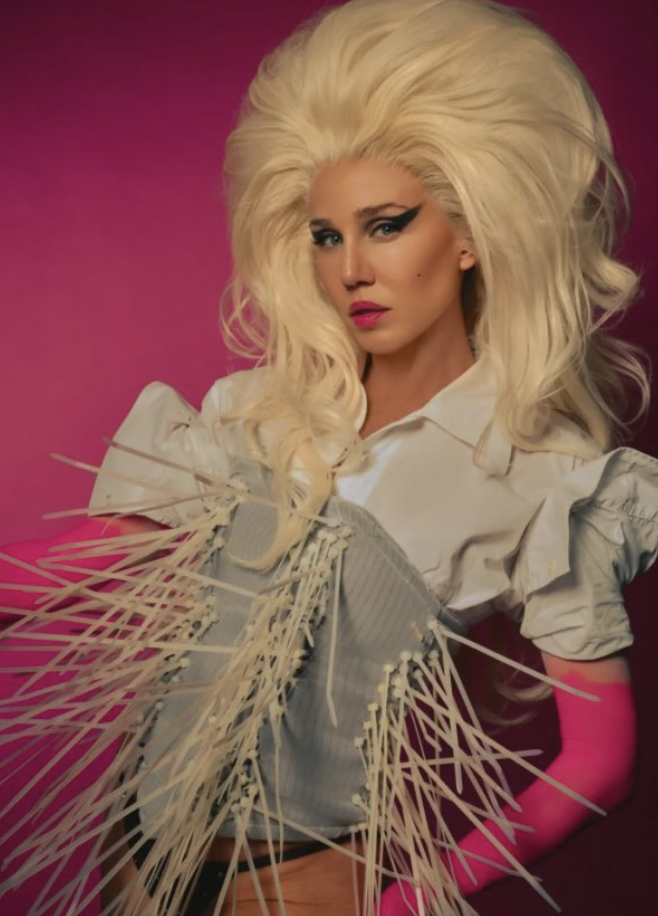
In conversation with BEKS: Turning Protest Into Pop
Words by Kasia Krawczyk
There’s something inherently punk about making people dance to an argument.
For BEKS, that instinct has been there long before TERF WERK became an unexpected internet phenomenon. Growing up in Bundaberg, Australia, she moved through ballet, country music, guitar, drums and eventually punk, becoming the drummer and frontwoman of the all-female band RACKETT. Along the way, she toured with The Darkness, Amyl and the Sniffers and DZ Deathrays before eventually falling headfirst into electronic music, DJing and pop songwriting.
These days, BEKS describes herself as “a punk rocker trapped inside a pop girlie.” It’s a joke, but also a pretty accurate description of the music she makes: glossy enough for the dance floor, loud enough to retain some of the sweat and attitude of her punk roots, and increasingly impossible to separate from the queer culture that surrounds it.
That combination came into sharp focus with TERF WERK.
The song began with a story BEKS saw online about a women-only pole studio on Australia’s Gold Coast and the debate surrounding who should be allowed into women’s spaces. What caught her attention wasn’t simply the argument itself, but the language being used to make it: “women’s safety” being invoked as justification for excluding trans women.
For BEKS, that framing hit a nerve.
“As a woman, I found that really confronting,” she says. “I don’t want my safety weaponised against another group of women.”
There was no elaborate songwriting session, no months-long development process and certainly no marketing strategy. The song arrived almost immediately. She wrote the line that would become its hook — “You gotta call it women’s safety while you do the TERF WERK” — recorded a rough version in her bedroom and put it online.
Then the internet did what the internet does.
The response was so immediate that BEKS went into the studio the following day to record the song properly. What had started as a spontaneous reaction suddenly had a life of its own.
“I didn’t even know if it was going to become an official song when I first posted it,” she says. “It was basically me responding to something in real time from my bedroom.”
The moment she realised it had become something bigger came not through a streaming number or a viral statistic, but through messages from trans listeners.
“I think I realised it had become bigger than the original post when trans people started sharing it and telling me what it meant to them,” she says. “It wasn’t just people thinking a lyric was funny or provocative. There were people who felt like somebody was publicly standing beside them at a time when they were being spoken about constantly rather than listened to.”
That distinction matters to BEKS. She is conscious that she is not a trans woman and has never wanted to position herself as speaking on behalf of trans people. Instead, TERF WERK is deliberately rooted in her own perspective.
“You don’t get to use my safety as the excuse for treating another woman like a threat,” she says.
That message might sound like the setup for a serious protest record. Instead, BEKS turned it into something camp, absurd and relentlessly danceable.
Even the title sounds like a joke designed to make an uncomfortable conversation impossible to ignore.
“It was already embedded in the original lyric and I loved the absurdity of turning something so ugly into something camp and ridiculous,” she explains. “There’s something very queer about taking language that carries hostility and making it dance.”
The song’s opening deliberately pushes the logic of policing women’s bodies into the realm of absurdity: somebody wants to dance, but before they can enter the space, their biology apparently needs to be checked. The more ridiculous the scenario becomes, the more invasive the underlying idea starts to look.
For BEKS, satire becomes a way of exposing that contradiction.
And the decision to make the song something you can actually dance to wasn’t accidental. It is, in many ways, the philosophy behind her entire sound.
“I love pop and club music because joy can be political too,” she says. “Protest music doesn’t always have to sound solemn for the message to be serious.”
That approach comes directly from her punk background. She hasn’t abandoned the confrontational spirit of punk; she has simply changed the setting.
“I came from punk music, and I think I’ve carried the attitude of punk into electronic pop,” she says. “I still want to say something; I just want to say it over a beat that makes you want to dance.”
There is something particularly powerful about that idea in a live setting. A protest song can ask an audience to listen. A club record can make them participate.
“For me, there’s something powerful about a room full of queer people dancing and screaming the same words together,” BEKS says. “Sometimes the most effective way to get someone to remember what you’re saying is to make the message impossible to get out of their head.”
Of course, putting a politically charged song onto the internet comes with a certain expectation: someone is going to be angry.
BEKS knew that.
What surprised her more was how little that possibility changed her mind.
“I’ve spent parts of my career trying to please everybody,” she says. “One of the hardest lessons I’ve learned is that doing that can dilute your autonomy.”
She isn’t interested in controversy for its own sake. There’s a difference, she argues, between manufacturing outrage for attention and refusing to stay quiet about something you genuinely believe matters.
“If something aligns with my values and I can stand behind what I’m saying, I’d rather say it clearly,” she says. “I’m not interested in manufacturing controversy for attention, but I’m also not going to avoid talking about human rights because somebody might leave an angry comment.”
It’s an attitude that feels particularly natural for an artist whose career has never stayed neatly inside one genre.
BEKS’s musical history is, by her own admission, “a bit of an identity crisis.” Ballet was followed by country music. Guitar and drums eventually led to RACKETT and punk. Then came electronic music, DJing and toplining, with songwriting taking her across Europe, the UK and the US.
“I’m essentially a punk rocker trapped inside a pop girlie,” she laughs.
The contradiction is now part of the appeal.
She loves the precision and escapism of pop and dance music, but still wants the guitars, sweat and sense of danger that shaped her earlier years.
“I play a pink guitar and look like a drag queen, but the mic is on.”
If TERF WERK introduced one side of BEKS to a wider audience, Melodrama opened an entirely different door.
The song found a new life through RuPaul’s Drag Race Down Under vs The World, where BEKS had an unusually personal perspective on the moment: she wasn’t simply watching from home. She was a guest judge on the season.
Then Melodrama became a lip-sync song.
Television production meant she had to keep the secret while the episode was being prepared, knowing something enormous was coming but unable to talk about it. Then, suddenly, the episode aired, and the internet discovered the song at the same time.
“What happened next” was something she couldn’t have manufactured if she tried.
M1ss Jade So and Michael Marouli performed Melodrama, and the song immediately became part of the Drag Race universe — a world where music can take on an entirely new identity once it is attached to a queen, a performance, a meme or a fandom.
“Drag Race has such a specific relationship with music because a lip sync can permanently change the way people experience a song,” BEKS says. “Suddenly it isn’t only your record anymore. It becomes attached to these queens, their performances, the memes and the fandom.”
Then came the Philippines.
“I became a meme, people started calling me Mother Milker, and suddenly there was this audience on the other side of the world making their own jokes and lore around my song.”
She pauses only long enough to deliver the inevitable punchline.
“I’ve learned that when the internet decides to milk something, you grab a bucket.”
It’s exactly the kind of absurdity that seems to follow BEKS wherever she goes: serious politics and ridiculous humour existing in the same space, sincerity sitting comfortably beside camp.
And now, after TERF WERK, the Melodrama remixes and her growing international audience, the different versions of BEKS that once seemed disconnected are beginning to look like one artist.
“The punk background, electronic music, pop songwriting, DJing, queer culture, touring, even the ridiculous internet humour — it’s all becoming BEKS rather than me feeling like I have to choose one version of myself,” she says.
That sense of integration seems to be guiding what comes next.
There’s new music, more collaborations and more touring on the horizon. Melodrama continues to evolve through remixes, while BEKS is interested in pushing her live show further into the space between electronic pop and guitar-driven performance.
The international side of her career is also accelerating. She is heading out on European tours with Allie X and Tony & The Kiki — two very different opportunities, and exactly the kind of challenge she wants.
“I’m excited to learn,” she says.
Supporting another artist, she explains, is its own kind of education. Every night offers a chance to watch how another artist and their team operate while simultaneously trying to win over a room full of people who may not have bought a ticket specifically to see you.
Touring with Allie X carries additional significance. BEKS has admired her work for years, and their shared connection to the Drag Race world makes the whole thing feel unexpectedly full circle.
Then comes Tony & The Kiki, bringing another audience and another live environment.
“I want to come out of both tours a better performer, with a sharper show and a clearer understanding of the artist I want to be internationally,” she says.
But perhaps the biggest attraction is the simplest one.
“Mostly, I’m excited by the challenge of walking into a room full of strangers and having half an hour to make them care.”
It’s a fitting challenge for an artist whose career has repeatedly been built on turning strangers into an audience.
A bedroom recording became TERF WERK. A pop song became a Drag Race lip-sync. A punk drummer became an electronic artist. A joke became a meme. And somewhere between the pink guitar, the club beats, the political lyrics and the increasingly international crowds, BEKS seems to have stopped worrying about which version of herself she is supposed to be.
Maybe the answer was always all of them.
And then there’s the question she gets from Starfreak Magazine — the one that perhaps sums up the whole BEKS philosophy better than anything else.
Is she a Star or a Freak?
Her answer comes without hesitation.
“A freak with star ambitions.”
Then she explains why you need both.
“The star gets me onstage in heels with a pink guitar, believing I belong there. The freak is the reason anybody remembers me afterwards.”