






 Interview with tg.blk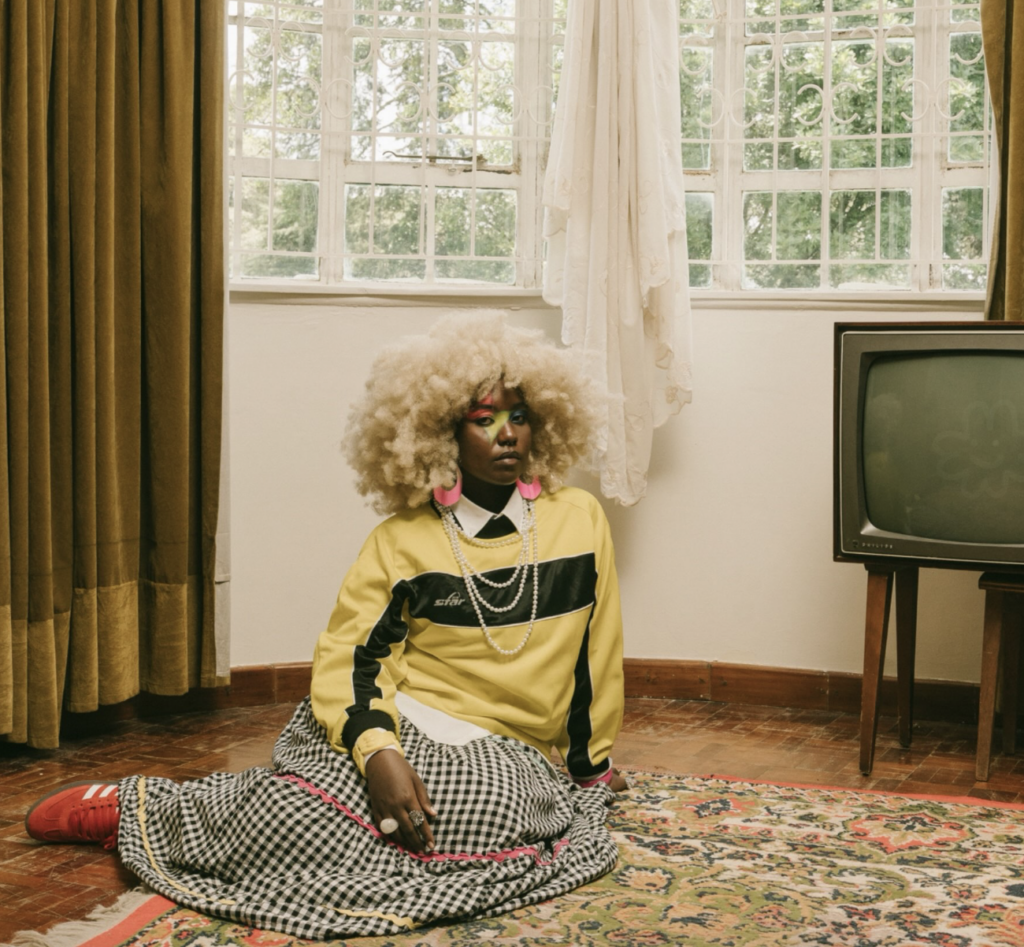
In conversation with tg.blk: The Artist Finding Freedom in the Space Between Rap, R&B and the Internet
Words by Kasia Krawczyk
For Nyathigi Gatere, better known as tg.blk, making music started with a laptop, a stack of YouTube beats and very little expectation that anyone would ever hear the results. Anonymity was part of the appeal. So was the freedom that came with it: no public image to maintain, no expectations to meet, no audience waiting to judge the next move.
Now, that distance is beginning to disappear.
Based in Kenya, tg.blk has built a sound rooted in rap but increasingly pulled towards soul and R&B, with the occasional detour into electronic territory. Her musical education, however, began less with rappers than with producers. Madlib, The Alchemist, 9th Wonder and J Dilla became as important to her musical vocabulary as the artists performing over their beats.
“I initially took a very special interest in producers more than artists,” she explains. “When I started making music, I was really just a listener.”
That instinct has stayed with her. Even as her own catalogue has grown, Gatere continues to search YouTube for instrumentals, convinced that somewhere among the thousands of uploads sits the next great beat — possibly made by someone with barely any subscribers.
“I know the world’s greatest producer; the next greatest producer of all time might just be on YouTube right now, uploading heat with 200 subscribers,” she says. “You know what I mean?”
It is an approach that makes sense for an artist whose career was born online. But while the internet gave tg.blk a place to experiment anonymously, her music has gradually become more revealing. Relationships, insecurity and different stages of emotional life have become recurring themes, culminating in the Besides You trilogy.
The idea came from something surprisingly simple: Gatere realised her own catalogue had become a kind of diary.
“I can tell what period of my life I was going through just by listening to my music,” she says. “I talk so much about my relationships. It’s all my business.”
Rather than treating that vulnerability as something to hide, tg.blk began looking at it as material. Relationships, after all, come with their own natural narrative arc — the rush of the beginning, the complications that arrive later, and the point where things either evolve or fall apart.
“There’s the first part, which is exciting and nice,” she explains. “Then there’s the middle, where it’s still kind of nice, but you’re noticing that it’s dying, but you still like this person. And then there’s the last stage where it’s just like, ‘Oh my gosh.’”
That understanding of relationships became the foundation for Besides You and its three-part structure. Instead of trying to squeeze everything into one definitive project, Gatere found a format that allowed her to explore the different stages and emotions at her own pace.
There was also a practical reason for breaking the story into pieces. “I’m kind of intimidated by the idea of making a complete project,” she admits.
For an artist whose work is so personal, the trilogy format offers room to breathe. It also reflects the way she has always approached music: instinctively, experimentally and without being entirely sure where an idea might lead.
That same freedom was there when tg.blk was still anonymous.
Initially, she kept her music secret from almost everyone around her. “I was telling maybe like 10 people in my life max that I was making music,” she recalls. What began as a hobby slowly developed into something more serious after a random song uploaded to SoundCloud unexpectedly connected with listeners.
“I was just making music as a hobby and it just sort of became something that I was more proud to show,” she says. Then came the moment that changed her perception of what was possible: “I was like, ‘Whoa, people actually want to listen to my music.’”
The decision to reveal herself was therefore less about chasing fame than about accepting that the music had become something worth standing behind.
“Why not? Let me put my best foot forward. Let me put my face out there. I have nothing to lose.”
There was another reason for the anonymity, too: fear.
“Part of the reason I was anonymous was just embarrassment, not wanting to be judged,” she admits. “It’s so scary to take a risk in front of people.”
That honesty makes her eventual decision to step into the spotlight feel less like a rebrand and more like a personal leap. She had spent years building music without having to worry about what anyone thought of her. Suddenly, there was a face attached to it.
Interestingly, though, the anonymous version of tg.blk may not be completely gone. Gatere still thinks about returning to that world — not necessarily because she wants to disappear, but because she misses the spontaneity that came with it.
“I think about it all the time,” she says.
The difference now is that making music has become more structured. There are plans, expectations and more moving parts. But for Gatere, nothing quite compares to the rush of finishing something late at night and immediately throwing it onto the internet.
“There’s nothing as exciting as finishing a song at 11pm and uploading it onto SoundCloud,” she says.
That instinct also defines her creative process.
Gatere doesn’t believe in waiting for the perfect moment to write. If a beat catches her attention, she wants to capture the first reaction before it disappears.
“If I hear something and I like it, immediately get to work,” she says. “Even if there are no words, even if there’s no structure, just put it down.”
She keeps everything, too. Half-finished ideas, scraps of verses and abandoned concepts all stay on her laptop. One of the songs on her most recent EP was almost lost among them, hidden beneath an unremarkable file name.
“One day I was like, there has to be something on my laptop,” she remembers. The file was named something ridiculous — essentially a keyboard smash — but when she opened it, she found the beginnings of something worth saving.
“I was like, ‘Oh, this is actually really nice.’ I’m glad I didn’t delete this.”
For Gatere, that has become an important part of the songwriting process: don’t assume an idea is bad simply because you aren’t ready for it yet.
“Sometimes that first idea is fantastic, and you’re not in the headspace to realise how good it is,” she says. “Just save it and pretend it doesn’t exist. Maybe in three months, you’ll be ready to understand what’s going on.”
The approach is fitting for someone whose musical identity has been shaped by digging. Her relationship with music started through listening — and, specifically, listening closely.
Rather than immediately gravitating towards the biggest artists, she became fascinated by the people constructing the sounds underneath them. Madlib, The Alchemist, 9th Wonder and J Dilla became key reference points, while MF DOOM, Earl Sweatshirt, Isaiah Rashad, Mick Jenkins and Playboi Carti have all influenced her taste in different ways.
“I really love the instrumentals,” she says.
Her love of production also explains why YouTube remains such an important part of her creative world. Even now, when producers send her beats directly, she still searches for instrumentals herself.
The idea isn’t as far-fetched as it sounds. Some of Gatere’s most important creative relationships began exactly that way.
One of them was Isaac, a producer she initially followed on YouTube before eventually working together. He produced much of her first EP and became an important part of her development.
Then there was Muddy Beats, a producer she met through Reddit during her anonymous days.
“I have so many friends from Reddit,” she laughs.
Those relationships weren’t simply about finding someone to make beats. They expanded her musical vocabulary and introduced her to sounds she might not have discovered otherwise.
Both producers became part of a wider online community that helped Gatere figure out her own sound before she had the confidence to fully claim it.
“If I didn’t have those guys, whatever sound I have going on right now would not be possible without the two of them,” she says.
“Just community. Just meeting people.”
That word — community — feels particularly important to Gatere’s story. Her career didn’t begin with an industry machine behind her. It grew through internet rabbit holes, anonymous friendships, producers uploading beats and strangers finding songs on SoundCloud.
Even the support she received from Vince Staples came through the music itself. Staples shared Gatere’s work, an especially meaningful moment for an artist who had once spent time rapping over Vince Staples-type beats on YouTube.
But the validation that matters most to her isn’t necessarily celebrity recognition. It’s connection with the people whose work shaped her.
That becomes clear when she talks about the future.
Ask most artists where they want to be in five years, and the answer might involve festivals, arenas or chart positions. Gatere has a different idea of what success looks like.
“In five years, I would love to be able to have my own tour. Like, a big one.”
Festivals are cool, she says, but they’re not necessarily the ultimate goal. Instead, she wants to build something that belongs entirely to her — a tour, an audience and a catalogue strong enough to take her music around the world.
Her definition of making it is surprisingly specific.
She wants the producers she has admired for years to know who she is. She wants to work with artists she has listened to since she was young. She wants to enter the same musical conversations as the people who first inspired her.
“I want it to be a situation where, in five years, all my favourite producers know who I am,” she says. “All the people I respect know who I am. I’m able to make music with all the people I’m into.”
And then there is the biggest version of that dream: an international tour, with listeners discovering her music in places she has never even considered.
“I’m going on a huge international tour,” she says. “People know and people love my music in random places. I can’t even imagine.”
For an artist who started by hiding behind a username, uploading songs to SoundCloud without knowing whether anyone would listen, it’s a fitting ambition.
tg.blk’s story isn’t really about moving from anonymity to visibility. It’s about what happens when an artist who made music simply because she loved it realises that other people want to come along for the ride.
The internet gave Nyathigi Gatere the freedom to experiment. Music gave her a language for the parts of her life she couldn’t otherwise articulate. And now, slowly but surely, that music is beginning to travel beyond the screen.
Not anonymity. Not celebrity.
Just the music — travelling further than she ever expected.
Photo by @capturedbyodede