





 Interview with Claudia Kate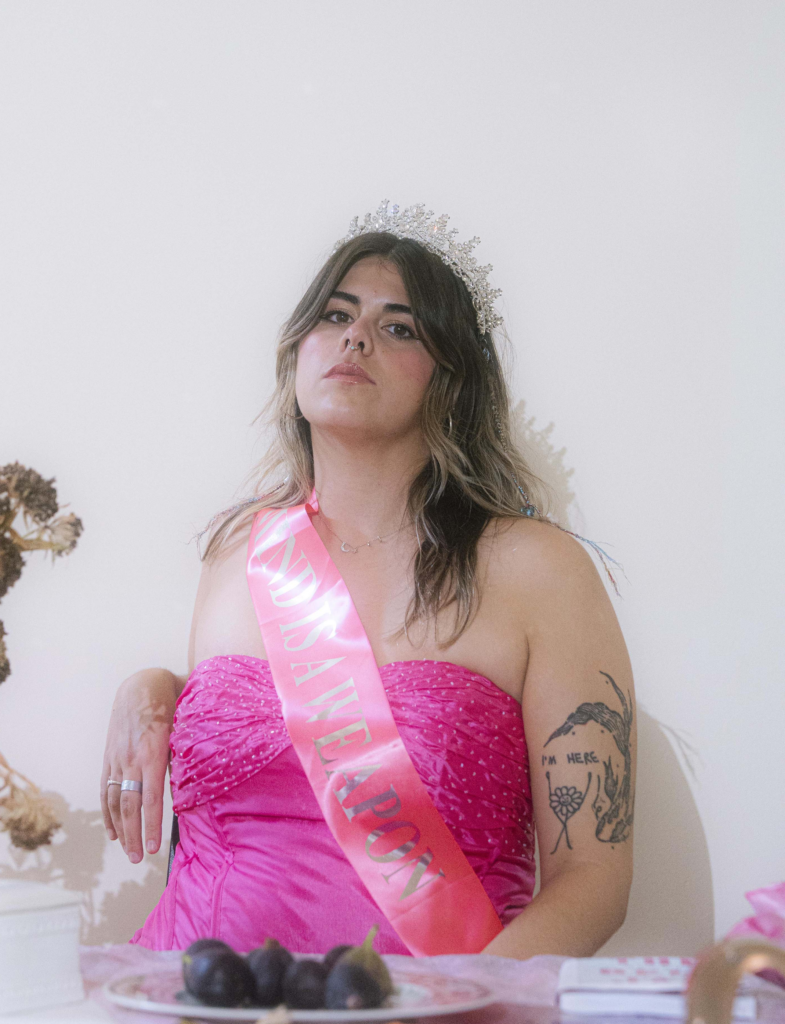
Claudia Kate Refuses to Shrink
Words by Kasia Krawczyk
Her new music pushes back against a world that has spent years telling women how they should look. Claudia Kate has another idea: choose knowledge over insecurity, independence over control, and a stage where you can finally be yourself.
For most of her life, the female body has been treated like a project that is never quite finished. Too big. Too small. Not defined enough. Too defined. Yesterday, one body type was fashionable; today, it is another. Tomorrow, the algorithm will probably invent a new one.
Claudia Kate has had enough.
“Growing up as a woman, I feel like my whole life my body has been such a big deal,” she says.
Her frustration isn’t simply personal. She is looking at a moment in which popular culture has once again become obsessed with the size and shape of women’s bodies. She points to the growing use of GLP-1 drugs and the transformation happening across Hollywood.
“I think people are shrinking,” she says.
That tension became the starting point for “Hungry,” a song that has grown into something larger than another release. It is a response to society’s obsession with appearance, but it is also a declaration of another kind of hunger — a hunger for knowledge, creativity and change.
At the centre of the song is a line Claudia wrote years ago: “My mind is a weapon, and she’s hungry.”
For her, the meaning is twofold.
“It’s that hunger for knowledge, that hunger to change things for the better,” she explains. “To speak out about things and connect with each other.”
It is also a pretty good description of where Claudia Kate is heading next.
Hungry for More
Claudia isn’t talking about success in terms of trophies, numbers or celebrity status. Her ambition is much simpler — and perhaps more radical because of it.
She wants the music to reach people.
“I just want my music to kind of reach more people and help more people,” she says.
That has always been part of the reason she writes: so that somebody listening on the other side of the speakers might recognise themselves in a lyric and feel a little less alone.
Her next album takes that idea further.
Titled My Mind Is a Weapon and She’s Hungry, the record is more focused than her previous work. Her last EP, How Sweet, brought together four songs she still loves, but each explored a different subject.
This time, there is a clearer centre of gravity.
Feminism. Power. Growing up. Finding your voice.
And the strange experience of entering your late twenties.
“I think as well that the transition into your late twenties is something a bit crazy that no one talks about,” she says. “My brain has formed.”
The music itself has matured too. Claudia has begun recording live in a proper studio, bringing her band into the process in a way she hasn’t done before.
She knows more now.
She trusts herself more.
And she expects you to hear the difference.
Taking Back Control
Claudia is unsigned — a position that gives her something increasingly valuable in an industry built around ownership: control.
There are obvious downsides. Without a label, there isn’t always the same money or infrastructure behind you. But Claudia has built her own team, turning friends into collaborators and collaborators into something resembling a family business.
And then there is ownership.
“There’s so much power in owning your own masters,” she says.
Her point becomes particularly sharp when discussing artists whose music can effectively be held hostage by the companies that control it. She points to Dylan, who recently spoke publicly about having two albums shelved by her label and fighting to release new music.
For Claudia, that situation illustrates exactly why independence matters.
Having an audience isn’t enough if someone else gets to decide whether that audience can actually hear your work.
Being unsigned may mean doing things the harder way.
But at least the decisions are yours.
The Double-Edged Sword
Of course, independence in 2026 comes with its own contradiction.
You may own your music — but you also have to become your own marketing department.
Instagram. TikTok. Posts. Comments. Algorithms. Constant connection.
Claudia sees the upside. A post she made about “body fascism” reached a huge audience, and even resulted in Alanis Morissette following her.
“Which is mental,” she says.
But the same platforms that can suddenly put your ideas in front of thousands of people can also become exhausting.
“You have to spend so much time on your phone and on Instagram,” she says. “It can be really draining.”
For an independent artist, social media can feel like a strange new version of the touring circuit: the room never closes, the audience never goes home, and someone is always watching.
Claudia’s solution is simple. Keep her comment sections positive and constructive.
Because if the point of the music is connection, the world around it should feel like somewhere people actually want to be.
Women Who Say What They Mean
Ask Claudia about her influences, and a pattern quickly emerges.
Alanis Morissette. Kate Nash. Lily Allen. CMAT. Olivia Rodrigo.
Different generations, different sounds, different careers — but all artists who have refused to stay quiet.
“I just love a female artist who’s not scared to say what they mean,” Claudia says.
That sense of solidarity matters to her. She talks about women’s festivals and creative spaces as places where artists can champion one another rather than compete for the same tiny piece of oxygen.
It’s part of a bigger philosophy running through her work.
Claudia doesn’t want to build a career entirely for herself.
She wants to pass things on.
Knowledge Is Power
Alongside her music, Claudia teaches. Singing, guitar, piano.
And she believes there is something quietly radical about sharing knowledge.
“If I’d had someone like me when I was that age, I would have been so grateful,” she says.
It is another form of empowerment: not simply telling young women that they are enough, but giving them the tools to create something of their own.
Learn the instrument.
Understand the industry.
Write the song.
Know your worth.
Then teach somebody else.
In Claudia’s world, knowledge isn’t an academic luxury. It is ammunition.
Just Go for It
If Claudia could speak to her younger self, she wouldn’t tell her to be more careful.
She’d tell her to stop getting in her own way.
“There’s no time for negative thought,” she says.
In the past, she might have thought, I can’t do that, and never tried. Or assumed someone would say no before she had even asked.
Now she operates differently.
She asks.
She tries.
And if the answer is no, she moves on.
There is a simple philosophy underneath it: if someone won’t open the door for you, find a window.
It sounds almost like a rock lyric.
And Claudia seems ready to live by it.
The Next Chapter
The album doesn’t have a precise release date yet. Claudia is taking an intentionally unconventional route, recording and releasing music as she goes rather than waiting for one grand, perfectly packaged album cycle.
She expects the record to arrive next year, around spring or summer.
Before then, there will be more songs, more collaborations and more shows.
One of the key collaborators on “Hungry” is Ellie Dixon, a friend Claudia has known for around a decade. Dixon also produced the track, bringing a sharp instinct for turning an idea into a finished record and helping give the song its nostalgic early-2000s production.
They finished it in just two sessions.
That kind of chemistry is difficult to manufacture. Sometimes it comes from years of friendship, shared references and knowing exactly when the other person has found the thing.
Claudia is also working with producer Rooks and collaborating with other friends as she continues to expand her musical world.
The record is being built in real time.
A little messy.
A little unconventional.
Very much hers.
The Dream Is a Festival Crowd
Ask Claudia where she wants to be in five years and the answer isn’t a corporate mission statement.
It’s a festival field.
A big stage.
Thousands of people singing her songs back at her.
“Everyone’s happy and smiling.”
That is the dream.
Not fame for fame’s sake. Not celebrity as an end point.
Connection.
Live music.
A crowd that knows the words.
Claudia says she feels most at home outdoors and at festivals. That is where her heart is: on stage, surrounded by people, watching a song stop belonging exclusively to the person who wrote it.
And perhaps that is ultimately what “Hungry” is about.
Not shrinking.
Not asking permission.
Not allowing someone else’s idea of what a woman should look like — or who she should be — to determine what she can become.
If listeners take one thing from the song, Claudia already knows what she wants it to be.
“You can do anything,” she says. “Don’t let the way that you look or what other people tell you you should be doing get in the way of what you want to do.”
Her mind is a weapon.
And it isn’t full yet.
Photo by Alia Thomas Photography