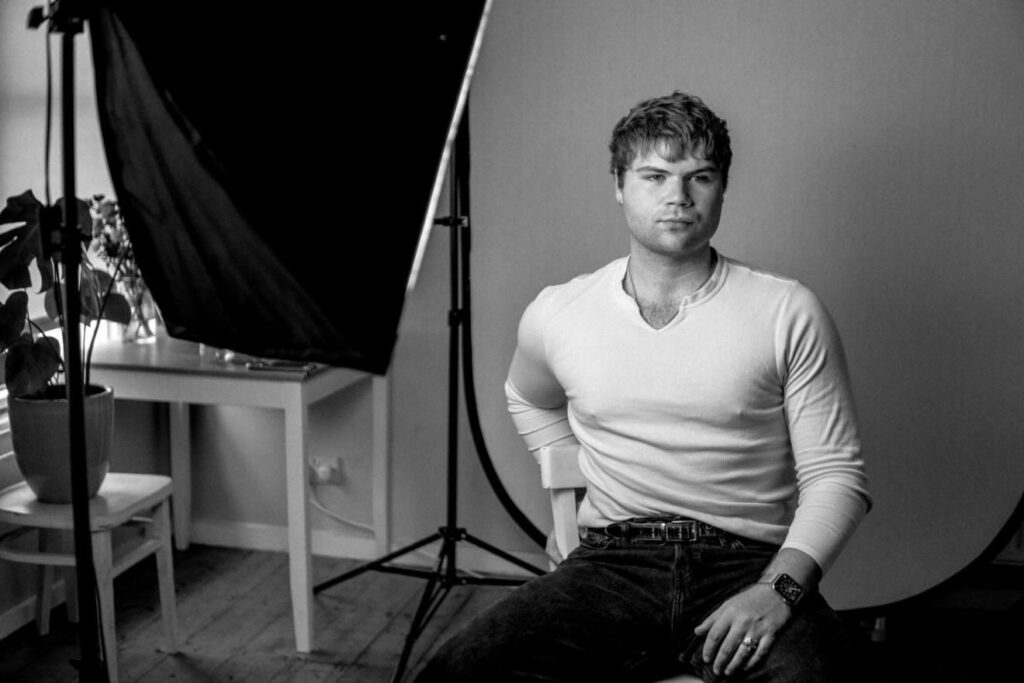






 Interview with Ethan McKinney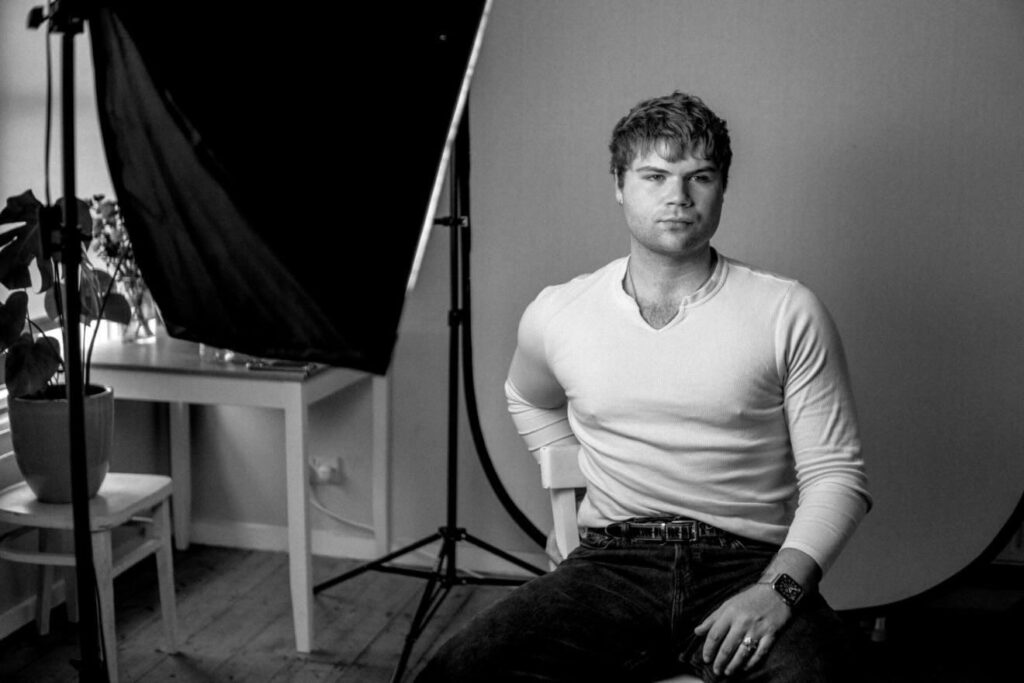
Ethan McKinney: The Space Between Certainty and Contradiction
Words by Julia Mastalerz
Emerging actors are often discussed in terms of where their careers might lead. More revealing, however, is the work they are already producing and the artistic concerns that begin to emerge across it. What distinguishes American actor Ethan McKinney, a London-based graduate of New York University’s Tisch School of the Arts with further classical training at the Royal Academy of Dramatic Art (RADA), is not simply the variety of material he has undertaken, but the consistency with which his performances return to questions of identity, contradiction and transformation. Across both classical and contemporary theatre, his work displays a sustained interest in characters who exist between certainty and doubt, public confidence and private vulnerability.
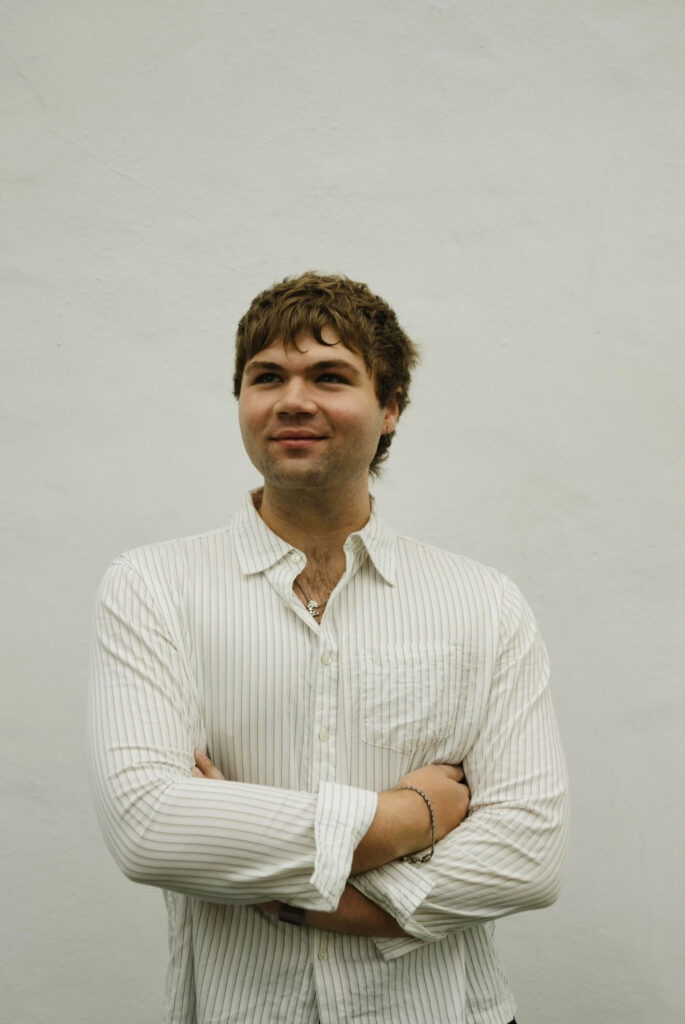
Rather than presenting characters as fixed personalities, McKinney consistently approaches them as individuals shaped by competing impulses. His performances resist easy moral categorisation, favouring ambiguity over resolution and investigation over judgement. Whether portraying authority figures, outsiders or men confronting their own limitations, he appears less interested in explaining behaviour than uncovering the conflicting emotional forces that produce it.
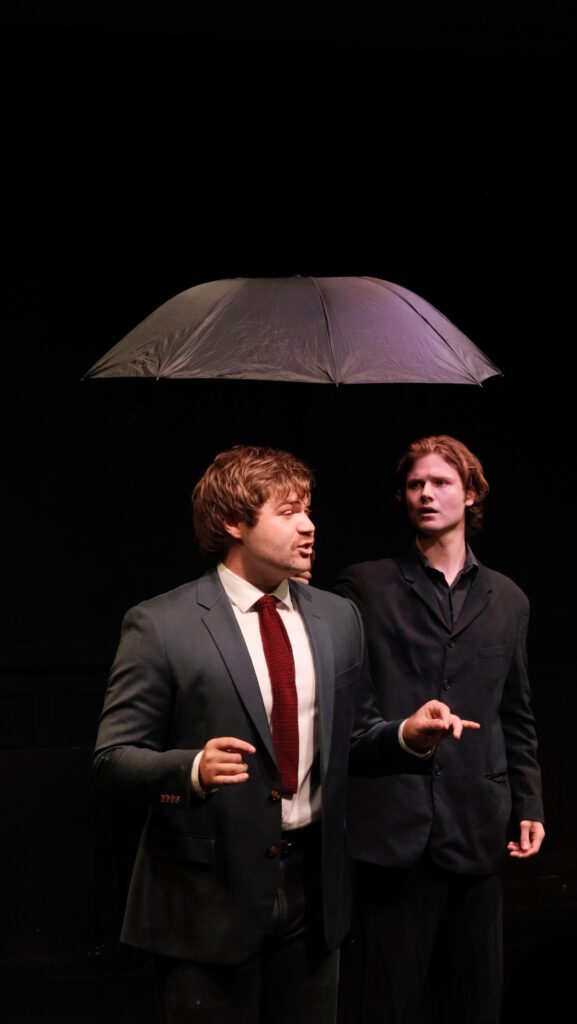
This consistency is particularly evident across recent performances. In The Winter’s Tale, his interpretation of Polixenes resisted the familiar reading of a ruler who simply descends into jealousy. Instead, the performance suggested that generosity and cruelty coexist within the same individual, with each emerging under different pressures. The portrayal avoided reducing the character to either hero or tyrant, allowing Shakespeare’s psychological complexity to remain intact. More recently, his performance in Don similarly shifted attention away from political caricature. Rather than relying on satire alone, McKinney located the emotional insecurity beneath the character’s pursuit of power, revealing how authority can often be driven as much by fear and validation as confidence. His performance found humour without sacrificing psychological credibility. Small changes in rhythm, moments of stillness and flashes of defensiveness revealed a figure striving to project authority while increasingly betraying his own insecurity. Although separated by centuries and radically different styles of writing, both performances demonstrate McKinney’s interest in the emotional tensions that shape human behaviour.
Equally notable is the restraint that characterises McKinney’s work. His performances rarely seek to dominate a scene through overt theatricality. Instead, they rely on careful listening, psychological precision and an evident trust in both the text and the audience. Moments of emotional revelation are allowed to emerge gradually rather than being imposed, creating performances that feel considered rather than demonstrative. Even in heightened material, there is a noticeable preference for truthful behaviour over theatrical effect, allowing tension to develop through conflicting impulses rather than external display.
That approach reflects a recognisable artistic methodology. Rather than adopting a different philosophy for each production, McKinney appears to approach every role through the same central question: what unseen conflicts shape a character’s choices? It is a method that privileges investigation over certainty, encouraging interpretations that acknowledge complexity rather than simplify it. Characters become neither puzzles to solve nor moral arguments to win, but fully realised individuals whose contradictions deserve sustained attention.
What makes this body of work particularly compelling is the relationship between McKinney’s intellectual interests and his practical performances. References to philosophy, psychology and classical literature emerge not as displays of scholarship but as foundations for his approach to character. Those influences are evident in the work itself, encouraging performances that favour observation over judgement and curiosity over certainty.
The result is an artistic practice with an increasingly recognisable coherence. Whether engaging with Shakespeare or contemporary new writing, McKinney consistently returns to unresolved questions: Can people genuinely change? How much of identity is inherited, and how much is consciously constructed? Where does conviction end and insecurity begin? His performances do not attempt to resolve those questions. Instead, they invite audiences to remain with them.
At a stage in his career when many performers are still experimenting with different artistic identities, McKinney’s work already demonstrates a clear and developing creative perspective. It is not any single performance that distinguishes him, but the consistency with which those concerns continue to evolve across different texts, characters and productions. The interview that follows offers further insight into the thinking underpinning that developing body of work.
Interview
You describe reinvention as a recurring theme in your life. Do you think reinvention is something we choose or something circumstances force upon us?
I think reinvention begins as a negotiation between the two. Circumstances present the question, but we ultimately decide how to answer it.
Looking back, every significant chapter of my life has emerged from a moment where an existing version of myself could no longer be sustained. Whether that was leaving North Carolina for New York or later moving to London, there was always an element of stepping beyond the boundaries of what felt familiar and certain.
I’m interested in the tension between the identities we inherit and the identities we construct. Most compelling characters exist somewhere within that space. They’re attempting to reconcile who they have been with who they might become, and I think that’s a fundamentally human pursuit.
Looking back, which move felt like the biggest leap into the unknown: North Carolina to New York, or New York to London?
New York felt like the greater personal leap because I was eighteen. It was the first time I’d left home, and like many young people, I was suddenly confronted with the question of who I was outside the context of my family, hometown and upbringing.
London was different. I had already spent time here training at RADA, so the city itself wasn’t entirely unfamiliar. The leap wasn’t moving to London; it was deciding to stay.
After graduating from NYU, I could have returned to a more familiar path in the United States. Instead, I chose to build a life and career abroad. There was no guarantee it would work, only the feeling that there was something here worth pursuing.
That experience reinforced something I find myself returning to artistically: growth often requires stepping beyond environments that have already defined you.
After building a life in the UK, what does the word “home” mean to you now?
Living abroad has complicated my understanding of home in ways I didn’t expect.
When I first left North Carolina, I viewed home largely as a place. Over time, distance transformed it into something more reflective. Being away has allowed me to see both what shaped me and what I’ve chosen to carry forward.
New York shaped my ambitions. London shaped my understanding of myself as an artist. North Carolina shaped the foundation beneath both.
That’s why I’m drawn to stories about belonging. Most people spend their lives trying to understand where they come from and where they fit. I think home exists somewhere in the conversation between those two questions.
How much of who we become is inherited and how much is consciously created?
I think we’re shaped far more by inheritance than we’d like to admit.
Our families, communities and histories leave fingerprints on almost everything we do. But adulthood is the process of deciding which parts of that inheritance to carry forward and which parts to challenge.
Many of the characters I find most interesting are wrestling with exactly that tension. They’re trying to determine whether they’re bound by their past or capable of becoming something new.
You’ve said theatre asks us to slow down and listen. Why does that feel especially important today?
We’re living through a period of extraordinary distraction.
Theatre asks the opposite of us. It asks us to be present, to remain curious and to sit in a room with strangers while giving something our complete attention.
That feels increasingly radical. Not because theatre has all the answers, but because listening itself has become a rare skill. Theatre creates a space where people can engage with complexity and ambiguity in ways that feel increasingly uncommon.
What can live theatre offer that film, television and social media cannot?
Risk.
Every performance exists only once. The audience and performers are creating something together in real time, and nobody knows exactly how it will unfold.
Film can be extraordinary, but it’s fixed. Theatre remains alive. In a culture where so much of life is mediated through screens, that shared sense of presence feels invaluable.
In Don, comedy is used to explore politics. Why can humour sometimes reveal truths that serious discussion cannot?
One thing that fascinated me about Don was that beneath its political framing lies something much more intimate.
During rehearsal I became increasingly interested in the relationship between power and insecurity. We often imagine power as strength, yet many powerful figures appear motivated by profound fears, wounds or unmet needs.
Comedy is uniquely suited to exposing those contradictions. We sometimes laugh at behaviour we see onstage only to later recognise ourselves within it.
You’ve spoken about finding meaning in the pursuit rather than the outcome. Was there a particular experience that taught you that lesson?
Moving to London was probably the experience that crystallised that understanding.
Like many young actors, I arrived with a fairly rigid idea of what progress should look like. Over time I realised that the most meaningful experiences were not necessarily the visible achievements but the rehearsal rooms, conversations, collaborations and gradual refinement of craft.
As with most things worth pursuing, meaning is rarely located in arrival. More often, it resides in continual becoming.
How has your relationship with rejection evolved?
Rejection used to feel deeply personal.
Over time I’ve come to understand that this profession is filled with variables beyond your control.
One idea I often return to comes from Stoicism: the distinction between what is within our control and what is not. We can prepare rigorously, continue training, remain curious and show up generously. What happens afterwards often has very little to do with talent alone.
Understanding that distinction has fundamentally changed my relationship with rejection.
Is there a question about human nature that you keep returning to?
I continually return to the question of whether genuine transformation is possible.
Many of the stories that move me most are concerned with that idea. Can people transcend the narratives they’ve inherited about themselves? Can they escape cycles of behaviour or belief?
I remember encountering this while playing Polixenes in The Winter’s Tale. Shakespeare presents him initially as a generous and thoughtful ruler, yet he becomes capable of extraordinary anger and cruelty. The character contains competing truths simultaneously, and exploring those contradictions only deepened my fascination with how people change—or fail to.
For me, that’s one of the great privileges of acting. The work continually reminds me that human beings are far more contradictory, complicated and, above all, capable of change than we often assume.
Conclusion
What becomes apparent across Ethan McKinney’s work is not simply thematic consistency but a distinctive approach to performance itself. His characters resist easy classification, occupying the space between strength and vulnerability, sympathy and culpability, and private impulse and public performance. Rather than offering definitive interpretations, his performances invite audiences to remain with complexity rather than resolve it.
That perspective gives his work a recognisable artistic identity. The questions that recur throughout his performances also underpin the philosophy articulated throughout this conversation. Rather than functioning as abstract intellectual interests, they become practical tools through which he approaches character.
There is also a discipline to McKinney’s work that distinguishes it. His performances demonstrate a willingness to trust silence, restraint and careful observation, allowing meaning to emerge through behaviour rather than explanation. Whether working in Shakespeare or contemporary theatre, he consistently privileges truthful human interaction over overt display, reflecting an actor more interested in discovery than demonstration.
Taken together, these qualities suggest an actor whose artistic identity is already becoming clearly defined. Across different genres and dramatic traditions, McKinney repeatedly returns to the same enduring question: how do people reconcile the person they believe themselves to be with the person circumstances ultimately reveal? It is the consistency, maturity and intelligence with which he continues to explore that question that makes his developing body of work worthy of serious attention.